Assisted Living vs In-Home Care Costs in San Jose, CA
A practical look at San Jose care costs, changing home-care schedules, often-overlooked household expenses and ways families can plan a sustainable next step.
Researching assisted living vs in-home care cost San Jose CA can make two very different arrangements look like a simple price comparison. One is a residential monthly median; the other usually begins with an hourly caregiver and a household that still needs food, upkeep and coordination. For adult children and spouses in San Jose, the useful question is not only which bill is lower this month. It is which arrangement covers the help needed, at the times it is needed, without depending on an unrealistic amount of unpaid family time.
The cost benchmarks below describe the San Jose Area, the metro region used for San Jose and Santa Clara County. They are not rates for The Rose Garden Elderly Care. A residence’s actual quote and a family’s home-care plan need to be evaluated separately, with services, schedules and possible additional charges written down.
Assisted living vs in-home care cost in San Jose, CA
These benchmarks show why a statewide estimate can understate a South Bay budget. They do not establish what any one home charges or what its rate includes. Care needs, accommodations and service packages can differ. Before comparing a residence with care at home, ask for a written schedule of charges and identify which support is included and which could lead to an additional fee.
How the comparison changes with caregiver hours
The assisted living median is included below only as a benchmark, not as an equivalent package of hours.
At 20 hours a week, paid care appears much lower than the residential median, but substantial time remains outside the caregiver’s schedule. At 168 hours, the monthly illustration rises far above the residential median. These figures are scheduling illustrations, not quotes; overnight coverage, caregiver availability and family backup still need practical answers.
A useful assisted living vs in-home care cost comparison for San Jose should map those hours onto an actual week. Mark who handles mornings, evenings, meals, appointments and nighttime needs. A lower invoice can still leave a spouse or adult child carrying a demanding schedule.
The costs of staying home that an hourly rate misses
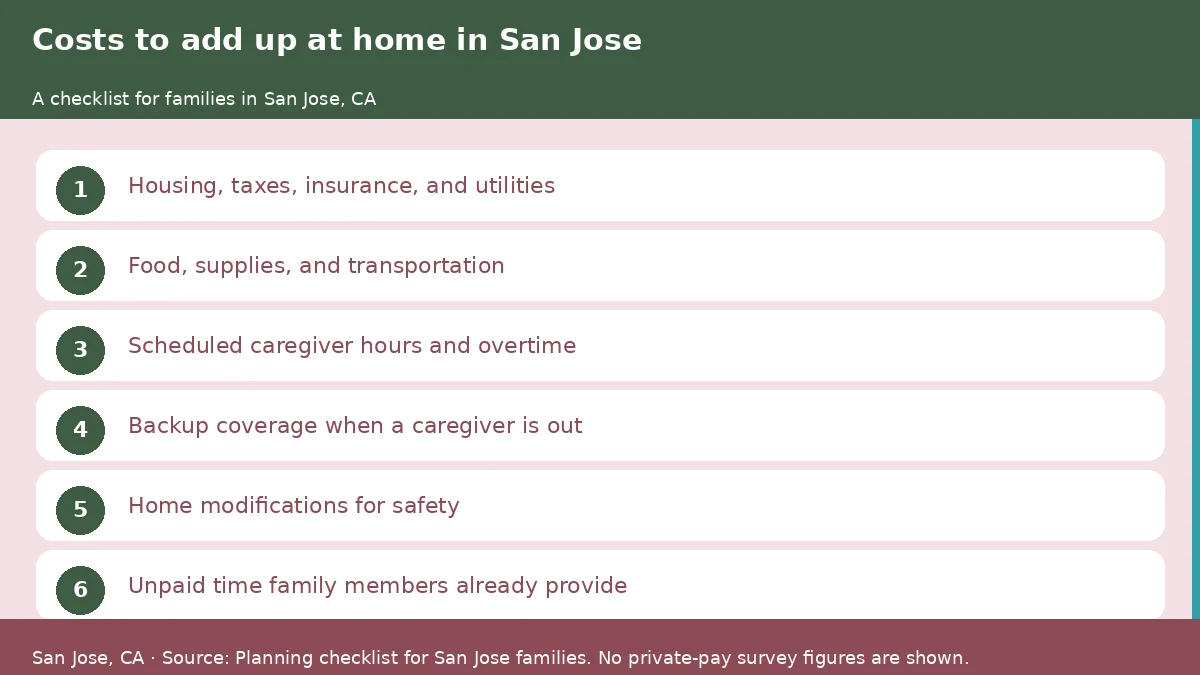
An hourly rate does not replace the household budget. Staying home can still involve housing costs, utilities, groceries, insurance, repairs, transportation and cleaning. Some homes may need grab bars, better lighting, a ramp or bathroom changes; others may need ongoing maintenance to remain workable. These needs vary, so they belong in a family’s own estimate rather than an assumed allowance.
There is also the cost of time, even when no invoice records it. Family members may fill schedule gaps, prepare meals, coordinate caregivers, handle laundry and leave work for appointments. A spouse may already be providing supervision throughout the day. A sustainable comparison counts that capacity honestly and includes backup for illness, vacations and caregiver turnover, without treating family availability as unlimited.
Compare the support provided, not just the setting
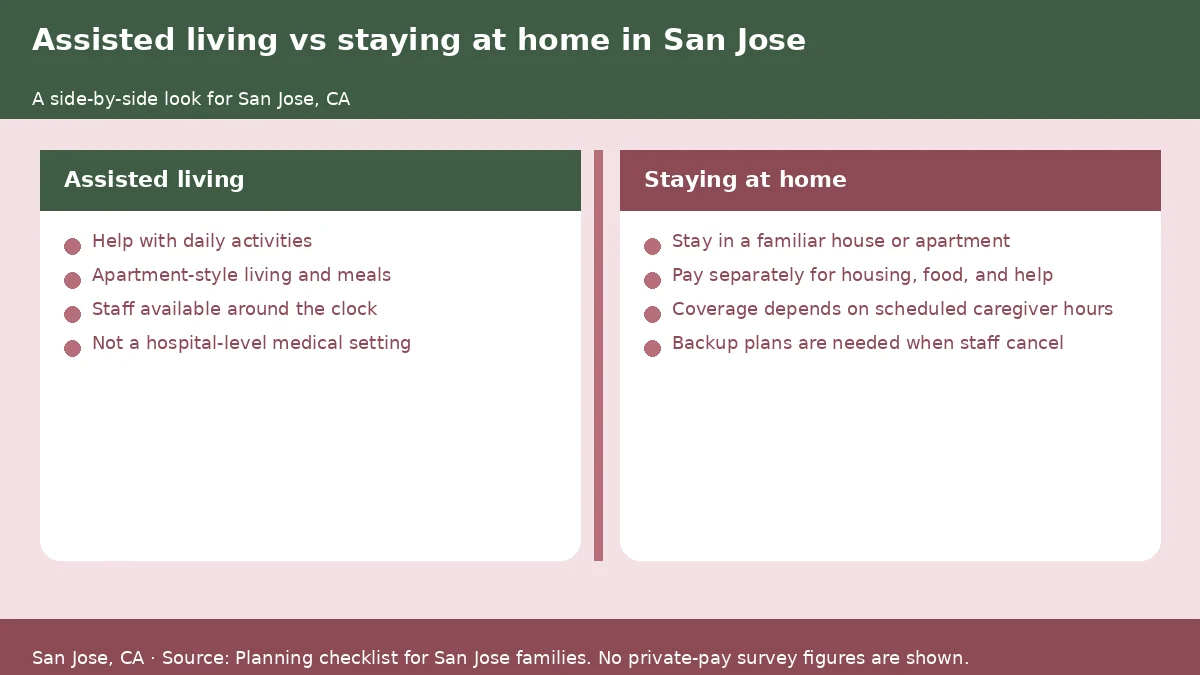
Start with tasks rather than a building. List help with bathing, dressing, toileting, eating, mobility, meals, laundry and medication reminders, then note when supervision is needed. In-home care can preserve familiar surroundings and provide focused help during scheduled visits. Assisted living may bring housing, meals and personal-care support into one setting, although the exact service plan and staffing arrangements must be confirmed with each provider.
For someone living with dementia, the number of task hours may not capture the need for consistent supervision and a supportive environment. Memory care should be understood as support, supervision and environmental structure, not as a treatment or a promise of a particular outcome. Ask how either setting would respond to changes in routine, mobility and nighttime supervision.
Where adult day care and nursing homes fit
It may provide scheduled daytime support, but it is not residential care and does not by itself cover evenings, nights or every weekend. Transportation and care outside program hours still need to be arranged.
Nursing home figures answer a different question. Price alone should not determine the setting; the person’s needs and an appropriate assessment come first.
Payment sources require careful verification
Medicare is often expected to fill the gap, but Medicare’s long-term care guidance explains that it does not cover long-term custodial care when that is the only care needed, and most long-term care is custodial. Families should not assume that either assisted living room and board or ongoing supervision at home will be paid simply because a person has Medicare.
Long-term care insurance may pay for assisted living or other services, depending on the policy. Benefits commonly begin after an elimination period and when the policyholder needs help with activities of daily living or has cognitive impairment. Read the actual contract for covered settings, benefit triggers, limits and required documentation rather than relying on the policy’s name.
VA Aid and Attendance can add to a pension for eligible wartime-era Veterans or surviving spouses who need help with daily activities or meet other criteria. The current VA pension rate table lists a maximum annual rate of $29,093 for a Veteran with no dependents, equivalent to $2,424 monthly only if countable income were zero. These are pension maximums, not automatic care reimbursements. Countable income and certain unreimbursed medical expenses affect the calculation. The net worth limit from December 1, 2025 through November 30, 2026 is $163,699, and VA reviews asset transfers and can impose a penalty period.
Medi-Cal’s Assisted Living Waiver can pay for assisted living services in participating RCFEs for people with full-scope Medi-Cal with no share of cost who need nursing facility level of care; the participant pays room and board. According to the California Department of Health Care Services waiver fact sheet, the program operates in Santa Clara County, but RCFE participation is limited and there is often a waitlist. Enrollment goes through a Care Coordination Agency after an RN assessment. Do not assume that a particular home participates or that funding is immediately available.
A local comparison in Berryessa and north San Jose
California licensing gives families another comparison tool. Assisted living is licensed as a Residential Care Facility for the Elderly, or RCFE, by the California Department of Social Services. The Community Care Licensing Division publishes inspection reports and operates a complaint hotline. RCFEs that advertise or accept residents with dementia must meet additional Title 22 requirements involving staff training, the environment and care planning.
The Rose Garden Elderly Care is a small, home-like residential care home at 2993 Knights Bridge Rd in Berryessa, in north San Jose. Its care information covers assisted living, memory care and respite care. Families should confirm current licensing, admission status and pricing directly by calling (669) 308-4198. Ask for a written description of included services, additional fees and the terms of any short stay. An overview of assisted living in San Jose can help shape those questions, but it does not replace a provider-specific quote.
Build a comparison your family can sustain
A side-by-side plan works best when both columns describe the same week and the same care needs.
- Record each task that requires help, including supervision and nighttime concerns.
- Build a home-care schedule that shows paid hours, family coverage and backup arrangements.
- Request written residential rates, included services and circumstances that could change the charge.
- Verify insurance, VA or Medi-Cal eligibility before assigning any expected benefit to the budget.
Respite care can give a family caregiver a short-term break. The National Institute on Aging explains that it may take place at home, in an adult day center or through a short residential stay. The Eldercare Locator can also connect San Jose families with local aging resources.
The sound choice is the arrangement that covers essential support without hiding gaps in supervision or exhausting the people providing unpaid care. A clear schedule, written charges and verified benefits make that comparison more dependable than a monthly figure alone.
Frequently asked questions
What is the monthly median cost of assisted living in San Jose?
These are broad market medians for the San Jose metro area, not a quote for any particular home. A family should request a written rate and a list of included services, care-level charges and other possible fees directly from each provider.
Is 20 hours of weekly in-home care cheaper than assisted living in San Jose?
That does not mean the two options provide equivalent coverage. Paid help is limited to scheduled hours, while family may still handle meals, household tasks, transportation and supervision. Home expenses and the residence’s actual service package also affect the comparison.
Does Medicare pay for assisted living or ongoing custodial care at home?
Medicare generally does not cover long-term custodial care when that is the only care needed, whether a San Jose family is considering assistance at home or in assisted living. Custodial care includes help with daily activities such as bathing and dressing. Families should separate questions about other covered services from the ongoing cost of supervision and personal care, and confirm payment responsibilities before care begins.
Can VA Aid and Attendance help a San Jose Veteran pay for care?
VA Aid and Attendance can increase a VA pension for eligible wartime-era Veterans and certain surviving spouses who need help with daily activities or meet other criteria. For a Veteran with no dependents, the listed maximum annual pension rate is $29,093; with one dependent, it is $34,488. These are not automatic monthly care payments. Countable income, unreimbursed medical expenses, assets and VA review affect eligibility and the actual pension.
How can a family compare The Rose Garden Elderly Care with care at home?
Start by listing the hours and tasks that home care would cover, along with remaining family responsibilities and household expenses. Then ask The Rose Garden Elderly Care on Knights Bridge Road in Berryessa about current licensing, admission status and a written rate for the appropriate care option. Families can call (669) 308-4198. Compare what each residential rate includes, ask about possible additional charges, and use the same daily care needs for both comparisons.
Talk with The Rose Garden Elderly Care
If you are weighing care options in San Jose, call (669) 308-4198 or plan a visit. Our team can talk through current availability, rates and next steps. Please confirm all details directly, since published figures and listings change over time.
Sources
- VA Aid and Attendance and Housebound benefits
- VA pension rates (current)
- Medicare: long-term care coverage
- Eldercare Locator (U.S. Administration for Community Living)
- National Institute on Aging: What is respite care?
- ACL: What is long-term care insurance
- California CDSS Community Care Licensing Division
- California DHCS: Assisted Living Waiver fact sheet (PDF)
Program rules and benefit amounts were checked on the linked official pages in November 2026 and can change.
Related reading on this site: